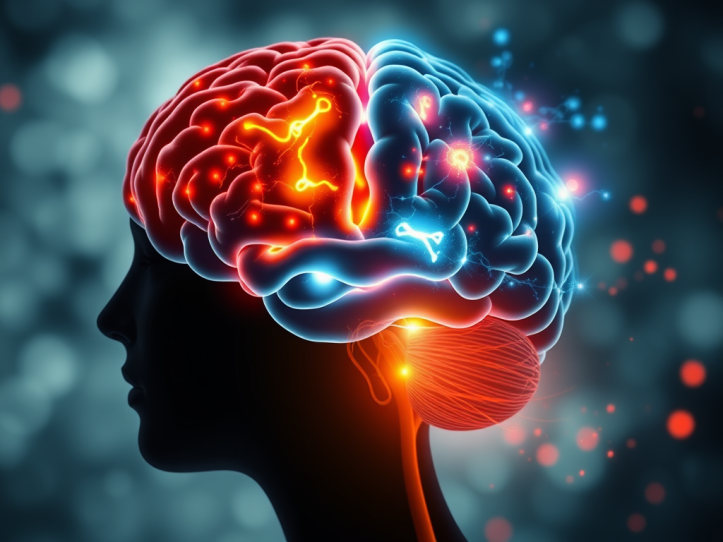
Thoughts have a physical form. All those fancy scans (EEG, CAT Scan, PET Scan, fMRI, SPECT) have as a purpose to take a look inside our heads. The interesting part is that activity can be seen.
Studies show that whenever we’re thinking about something, some parts of our brain light up like Santa’s eyes when he sees a cookie. Therefore, our thoughts create electrical activity in our brains.
In this chapter, I described a very simplified view of how we are physically affected by the negative thoughts, but first I need to define what I mean by positive and negative thoughts and behaviors. With positive, I mean thoughts and behaviors that help the wellbeing of an individual, while with negative I refer to thoughts and behaviors that are more harmful in the long run.
For example, the thought “I suck” can be seen as positive if it motivates us to become better so we can suck a little less. However, the same thought can be seen as negative if it triggers some anxiety or depression that lowers the self-esteem, the self-confidence and it makes our life worse.
“Who cares? It’s not like the brain can make a physical difference between positive thoughts and negative thoughts!” Well, in his book Evolve Your Brain: The Science of Changing Your Mind (2007) Joe Dispenza talks about how do our brains make a difference between these two types of thoughts. Most of us have neurons, right? Between those neurons there is a small gap called synapse. That synapse is filled with some chemical things called neurotransmitters, which have as a purpose to pass the information from one neuron to another.
When we’re thinking about something nice, our brains release some good neurotransmitters like dopamine (the reward chemical) or serotonin (the happiness chemical) to fill that gap so the information can be passed to the next neuron. These two chemicals can make us feel good. When we’re thinking about things that can make us feel bad, our brains fill that gap with neuropeptides and then we feel bad (e.g. dynorphin, neuropeptide Y or corticotropin). Serotonin and dopamine make us feel good and because of this, we want for more. Since we are so smart, we found ways to do this. This is where addictions come into place. Drugs, alcohol, tobacco, movies, video games, chicken nuggets, taking a dump at home after we had to hold it for a few hours and so on, they all release dopamine.
This is a passage from my book Fighting The Inside Dragons (excepting the image). I discuss how different our thoughts are regarding its biological nature. This is explored in the chapter Our psycho-bio path. If you want to grab the full book and read more about it, click on the links below.
very well written. A lot of the biology between inside and outside is hard to understand for those who don’t think in this way, or have the background, but you have done a great job here of explaining it in a way that people can relate to. That’s the key, taking something advanced and making it useful for the masses, speaking in a way folks can understand. Brilliant. I love it.
Oh, my goodness, I am so excited you asked me this question. People don’t usually, so it took me aback in the best way possible, so thank you. Truly made my day. I think the most surprising thing about the mind-body connection is that it’s never done. It seems to never be done. The more you expand, the less you feel attached to either as an individual. It’s as though with time and practice and a lot of generous love, the body starts to lose its control as the mind expands. And it’s limitless, I think that’s the thing that has surprised me the most. I sincerely am grateful you asked me this and I hope you have a wonderful day.


 BI Author
I hadn’t really considered thoughts a physical thing before.
LikeLiked by 1 person
I never thought either until I did the research for writing my book. Thanks for being here!
LikeLiked by 1 person
My pleasure.
LikeLiked by 1 person
Fascinating and inlightening!
LikeLiked by 1 person
Thanks!
LikeLiked by 1 person
Welcome!
LikeLiked by 1 person
This is a fascinating topic would love to read more ….
LikeLiked by 1 person
Thank you! Check out the book or other posts to view more.
LikeLike
thank you for your like i appreciate you
LikeLiked by 1 person
It’s very difficult to separate the mental from the physical… and I don’t think I’d even want to!
LikeLiked by 2 people
We don’t even have to. But maybe if we realize the connection, we pay more attention to what happens inside.
LikeLiked by 3 people
very well written. A lot of the biology between inside and outside is hard to understand for those who don’t think in this way, or have the background, but you have done a great job here of explaining it in a way that people can relate to. That’s the key, taking something advanced and making it useful for the masses, speaking in a way folks can understand. Brilliant. I love it.
LikeLiked by 1 person
Thank you! What do you think is the most surprising thing about the mind-body connection?
LikeLike
Oh, my goodness, I am so excited you asked me this question. People don’t usually, so it took me aback in the best way possible, so thank you. Truly made my day. I think the most surprising thing about the mind-body connection is that it’s never done. It seems to never be done. The more you expand, the less you feel attached to either as an individual. It’s as though with time and practice and a lot of generous love, the body starts to lose its control as the mind expands. And it’s limitless, I think that’s the thing that has surprised me the most. I sincerely am grateful you asked me this and I hope you have a wonderful day.
LikeLiked by 1 person
It’s my genuine pleasure. Have a wonderful day!
LikeLiked by 1 person
you as well
LikeLiked by 1 person